A young man in Manipur once commented under a YouTube music video of Mizo music artist H.O.M (House of Madness), “Listening from the frontlines and missing home.” An arresting image—someone caught in the throes of state violence finding solace in a song not written in his mother tongue. It captures the unlikely impact of a Mizo artist whose rise has been nothing short of remarkable.
This Mizo artist to reach 1 million streams on a song on Spotify had only been in the scene for a little more than a year at the time of reaching this milestone. And the frontman barely looked 23 when they made this achievement. Mizoram has a population of a little over 1.5 million and songs in the regional language would have to capture the hearts of all Mizos – young and old – to gain this level of attention, especially from a relatively and deliberately elusive artist.
Lude, the face of House of Madness (H.O.M.), dons a mask on stage and his identity had been a mystery among fans for a little over a year after his viral song “Siali” filled us with a renewed love for “old music”. In early 2025, the mask came off, rather unspectacularly on an Instagram Live, to a wave of squeals from at least five young women in my knowledge. Few Mizo artists had perhaps channeled the power of social media like this rising star, whose branding as the masked man (funnily earning him the nickname of “Mizo Rey Mysterio” among some local internet users) with signature neon colours and a cyberpunk aesthetic, played at a different game than his predecessors. Savvy, cosmopolitan and extremely Gen-Z-core, H.O.M. introduced a virality one could describe as internet-friendly—very memeable, generous with backstage access through Lives, and quick to repost and encourage fans to place him in catchy reel formats.
On the first listen, the unsuspecting might be fooled into thinking the hit song is from the 60s—its characteristic touch of vinyl being played on an old record player. This is not to say H.O.M. was the first to make such music, but it speaks to the wave of nostalgia the artist has fanned as classic music takes over the playlists of the new generation. The songs didn’t just resonate but transported those of us who have lived away from “home,” and grown up listening to old tapes belonging to our parents that hummed all day as life went on, to a childhood memory.
H.O.M.’s unprecedented rise could be just about the music, and like much of Mizo popular music, it cut across to neighbouring states—and a significant listenership emerged in conflict-ridden Manipur. In 2024, H.O.M. and another young artist, Mary Dawngi, visited Lamka town in Manipur to perform for a big slice of their audience—many of whom sang along to every word.
For many of us, H.O.M.’s rise coincided with a period of grief and finding healing in community—the kind that makes you believe grief is lessened when shared. The Manipur conflict broke out in May 2023. It took only a few days for complete lawlessness to become every day and to completely break hearts, friendships and the sense of belonging to the places we once called “home” in varying degrees. Many writers speak of it, but there is no one way to describe the idea of finding your real place of belonging or, at least, examples to take the lead from when it is time to rebuild the foundation of “home.” The outpouring of love from neighbouring Mizoram for kindred tribes—the cultural and familial affinity among us and, most of all, the relatively stable reputation of the state after a violent history—drew us to the Mizo cultural landscape for some temporary respite or, more dangerously—hope!
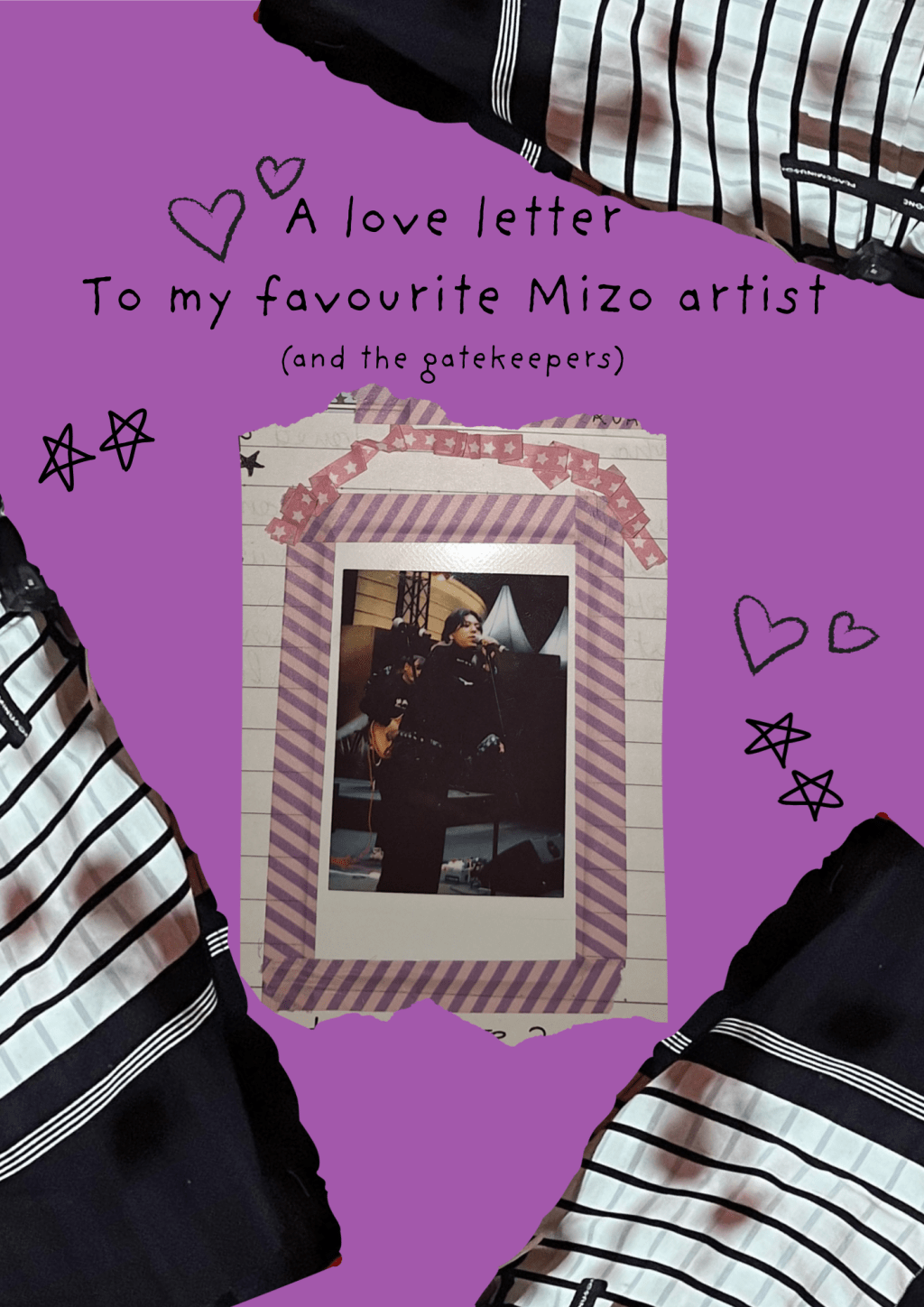
For this listener, H.O.M. was the placeholder for that hope—the music presented itself to me as relevant and timely. Ever since I heard my first H.O.M. song, I knew I had to see them in the flesh. The first time was on the last day of the Lengkhawm exhibition in India International Centre on remembering the creative history of Lamka town. Needless to say, it felt like destiny itself had wanted me to end this period of community effort and rememberance with the music that had held my hand through it all. That was September 2024, and the frontman still had his mask on and maintained his mystery. He didn’t speak much but agreed to a photo in any pose I pleased.
More than a year later, in December 2024, I was in a position to professionally advocate for H.O.M. to perform at the biggest annual event hosted by our place of work. Counting down the months, overcoming every hurdle that could have made this concert not happen, H.O.M. performed at the event—and in attendance were a good number of listeners who didn’t speak Mizo as their first language—both from outside the Northeast region and many many from neighbouring Manipur.
That night, a certain person close to the band was heard reporting that the crowd did not have many Mizos. Only “Mizo wannabes”.
This phrase cuts deep, especially for a minority community that is presently undergoing an unimaginable time of sacrifice and perseverance to retain a particular identity because they do not want to assimilate with another. As a knee-jerk reaction, I thought out loud: where are the “real” ones to support the band anyway? But of course, there is political nuance, vested interests and actual aspirations behind why this phrase even took off.
With family on two sides of the state and of the national boundary running through the region, one intuitionally understands the reasons for gatekeeping activities and is simply bored of proving affiliation to any one side. However, some instances in the past few weeks forced me to go beyond intuition and do the more difficult labour of making sense of how Mizo art of today itself is not made entirely by the Mizos of today.
For my birthday, my maternal grandmother (a Hmar woman whose ancestry is in Pherzawl district of Manipur) sent me the last of the puan/puon (traditional wrap) she had woven before her eyesight, fingers and responsibilities left her with fewer resources to continue her craft. This included the black-and-white striped Ngotekherh or Ngotekhelh—one of the shared cultural markers of different Zo tribes. Even wearing this wrap to an event was a decision I had to think twice about—because there is some contention over whether Paites (my birth tribe) have “appropriated” the puan/puon and whether the Hmars (my grandmother’s tribe) are even in fact the original weavers of the textile. The Ngotekherh is also GI-tagged in Mizoram, and lived experience has taught me that gatekeepers do not fathom that the cloth and craft can travel beyond the Tuivai river, where modern-day Mizoram ends and Tipaimukh, Manipur begins. This border town is only a few hours from the birthplace of my grandmother’s maternal uncle, known as one of the greats in Mizo literature, who lived and passed as a proud Hmar man from Pherzawl. It was this great uncle who bestowed upon me his typewriter—symbolically passing on the writing chops, just as my grandmother (half-succesfully) taught me the art of weaving. Sometimes, I wonder if there was some unfortunate hybrid in those days who “stole” creativity across tribes as well.
That said, being territorial about creativity is not new, despite there being a more productive option of turning it into a resource to create a bigger world. Creativity, whether through the times of the literary great uncle, the weaving grandmother or a masked social-media savvy singer, has always been bridging continuity and binding people in an allyship that has repeated over hundreds of inheritances and hope for continuity. Creativity, I think, is perhaps the common language we are in search of to become a greater whole than a sum of our tribal parts.
Even as “Siali” is sure to echo through time as a classic, H.O.M. is far from a one-hit wonder or boxed in as the guy with the retro sound. Beyond this magic formula, H.O.M. lives in its music and intuitionally creates art, continually experimenting with classics, then jumping to industrial metal, before releasing satisfying pop beats reminiscent of the 2010s or teasing with a lo-fi indie sample more emblematic of Generation Z. And all the while, a long-time listener of this artist who is just getting started, hears hints of someone at the cusp of finding that one sound that is fully H.O.M.
 The Balled-Up Paper
Leave a comment