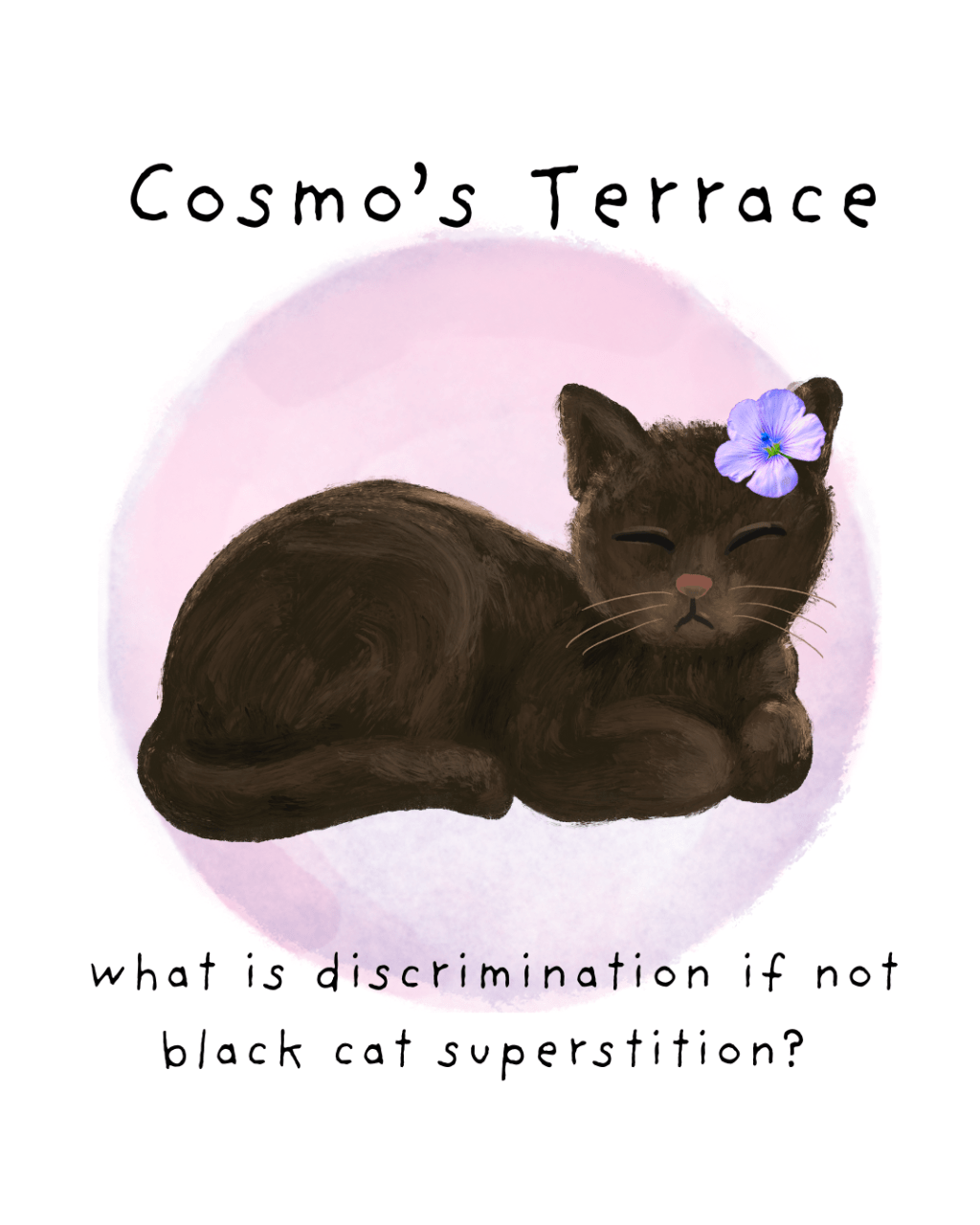
Sometimes I cry over things that should not matter this much. Like the intruder black cat who has decided to become a squatter in Cosmo’s (my five-year-old cat) luxurious outdoor terrace space, with its running-around expanse and multiple beds prepared by my pseudo non-pet-person mother. It was my fault – I started feeding the black cat Cosmo’s leftovers because my spoiled kid will not accept soggy dry food, which doubles up as soon as the weather becomes humid.
The black cat began trusting me, rubbing itself on my family members, and begging with a human-like insistence to be adopted. She ate every supplement and medication that Cosmo would reject even when powdered to dust and sprinkled lightly over the stinkiest fish treats to fool his sharp nose. She was easy to handle and she had beautiful green eyes, with pupils that dilated whenever she looked up from her nap as if to say Hi.
I instantly loved her and enjoyed her presence – but only until it began bothering my own. When I had to choose between “my” cat’s well-being and hers, I betrayed and chased her out with the vile spirit of a displacer. It is called projection, I am aware – but these past events remind me of the fragility of belonging in today’s world separated by walls – that is why I cry a lot these days.
For three months they tried to coexist – tense but possible, I tried to convince myself. They even slept side by side on the balcony once or twice. But alas, Cosmo comes from generations of feral cats and he remains territorial. He tries in his own way to tolerate, until he gets too close and she scratches him. Then he scratches himself, overgrooming, biting, leaving his face torn and battered because he is as prone to anxiety as he is to his territorial instinct.
So, one day, I upturned all the bedding and cleansed the entire terrace with lemongrass oil (cats hate citrus smells it seems). When it didn’t work, I threw a bucket of water at her, and it undid me. Perhaps, it truly is only a small act of betrayal, but I was angry at Cosmo for hoarding and for turning me into the enforcer of displacement and cruelty.
My current research fieldwork in refugee cuisine prepared me for this. I fear asking about people’s lives in displacement or being perceived as a nosey intruder, so I had earlier decided to study food (also, it was a terrific self-mandated opportunity to eat tasty food).
Why does one refugee cuisine become Delhi street food while another refugee cuisine stays marginal? – I asked on paper.
Very soon, and as I suspected, the research question and food itself became a surrogate for real lives. Why does one refugee group become visible while another remains invisible? These aren’t just accidents of taste but deliberate engineering of who the systems view as PALATEABLE.
Growing up in Delhi, we somehow have found relative ease in accepting a multicultural existence without much curiosity or thought to “original inhabitants” or “owners of the land” because the city has been a refugee city since its modern existence. Even those we casually considered “OGs” would be from Old Delhi or West Delhi’s ancestral bungalows in Punjabi Bagh or the independent homes of South Delhi in and around CR Park – entire neighbourhoods whose histories were shaped by families who settled after Partition, on either side of imaginary lines drawn on a map.
Today, displacement is still happening in a loud and proud yet disturbingly silent way. In Jharsa village, next to my Gurgaon accommodation, I go out for an insomniac ciggie to the balcony and spot people carrying their things – wound in a bedsheet and tied – over their backs. In my mother’s home in Vasant Kunj Enclave, the Bangla-speaking man from Rangpuri Gaon who washes our car was evicted by (what they say was) the Delhi police in the dead of the night. Last I heard, he is alive but forced to rent another room. I don’t care to know which side of the border he came from and knowing would not change my mind about how I feel in this situation.
I look at Cosmo, and I think.. you have enough. I have enough – enough food to feed both, enough space for both, enough love even. It would be ideal if Cosmo could see that, if he could just unclench and let her in. His refusal makes me angry because I’ve seen it before, not in my cat but in people – strangers on the internet, my own kin – repeating the same misguided thought: the outsiders – the immigrants and the refugees take from us.
Take what? It’s not about bowls of food or square feet of space. It’s not about scarcity but about perception – about the fear of sharing, the territorial instinct that mistakes belonging for threat.
Cosmo’s cruelty reminds me of something older, too: indigeneity itself, built on instincts of survival. Protecting herds and grazing grounds, making sacrifices for winter, securing futures for one’s kin – even if it is at the cost of others. But we are not herders at the edge of extinction.
Nor are we cats.
We should know better that we have long thought in and within systems that control our society – the matrix is the maze of numbers and algorithms in your smartphone that push you to think one refugee cuisine is more worthy than another or that one child’s life is more valuable than another.
It is no coincidence that all these systems are currently tapping into our primal animalistic instincts, which insist belonging and resource is scarce and that empathy is weakness. These instincts are not born out of need but engineered by greed. They are not natural instincts but a monstrous clone created in labs, deliberated, planned, approved, executed in exact measures. The same labs once created borders, partitions, laws, papers unnatural to our world.
Yet, the world accepts this as natural. Even educated. We dismiss what is essentially mass hysteria — a kind of modern superstition — as rational thought. Think of the widows shunned for being charmed, the ones who could pollute you by a touch, the ominous black cats who bring misfortune when they cross your path. We create the damned, then blame them for learning to live off scraps. And if they are caught eating from a discarded bowl just to survive, we uproot them again. Acceptance is never free; it is always conditional, brittle, and granted only at the mercy of those who decide who belongs.
The black cat still returns sometimes. I still throw water to emphasise she is unwelcome, I shut the door but I cry at night. The tragedy was that she trusted, softened in a world that prepared her to be guarded and hardened, only to get burned once more. In her pupils, where I once saw trust and desire to belong, I now see the slant scared precocious and empty eyes of a feral who knows belonging is a gamble she may never win.
 The Balled-Up Paper
Leave a comment