It had been raining since morning, and the five of us continued to sit around the hearth through tea and even past dinner. In a sleepy Northeast state where nights are long (particularly so when there is a power cut), conversations meandered through time and space, and somehow landed on this question—what’s the “most unusual” name you’ve heard out here? “Between First Gear, Second Gear, and Third Gear (the real names of three siblings whose father was a mechanic, obviously), it’s hard to choose,” says one of them. I began laughing as everyone does, feeling the all-too-familiar guilt that I have betrayed my own.
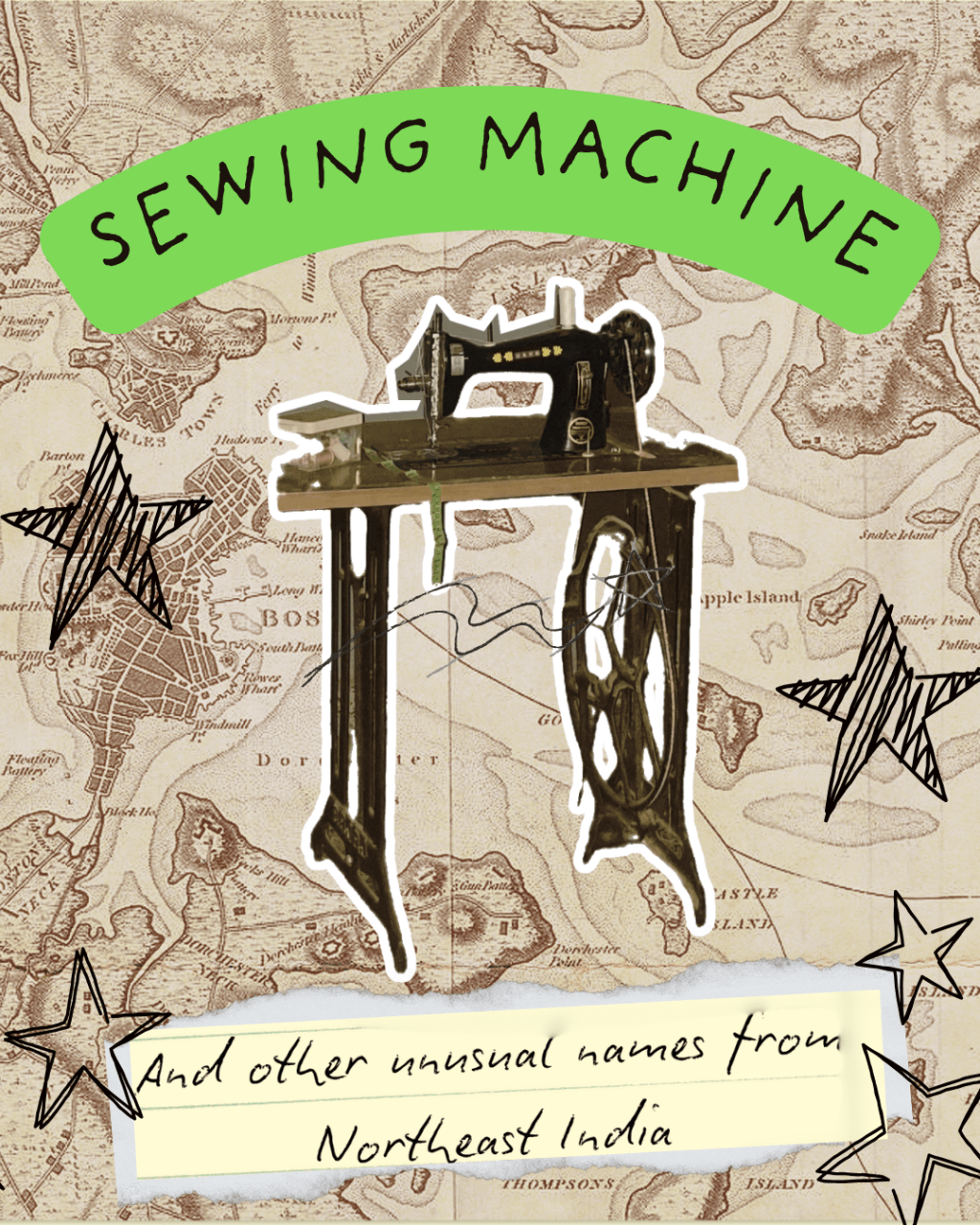
My father’s name is Sewing Machine. Not in English, no.
My father’s name is Khawl-rem-thang, and it was only a few weeks ago that I discovered he was named after a sewing machine. But it was no ordinary sewing machine. The origin of this particular legendary device can be traced back to World War II, when fighter planes from the Allied forces crashed through the skies above, and sometimes into, the Lushai hills.
The world still does not know how many planes went down over the treacherous but essential aerial supply route known as “The Hump”. When the Japanese imperial forces cut off the main supply route to China through Burma, American pilots would fly from air bases in Assam, across the eastern Himalayas, to supply the Chinese troops. Thick forests, sudden weather changes, and enemy fire made these missions perilous and as many as 600 aircrafts never returned.
The Hump seems to be a forgotten piece of the past, but buried even further beneath it are stories of communities who, at the time, inhabited the land under cursed skies. Wreckage from a global war scattered across forested mountains, thrown off history’s course and into oblivion where lived curious villagers who would climb through the dense undergrowth to find what remained—metal, bolts, wire. My great-grandfather was one of them—a particularly determined one who, from pieces of those fallen planes, was able to engineer a working sewing machine.
He was so pleased with himself, his act of reclamation, of making something whole from devastation, that when a grandson was born, he called him Khawl (Sewing Machine), rem (to assemble), thang (famous).
My grandmother’s name? Sum-za-chong, where Sum-za translates to mean “Money Hundred”. When Sum-za-chong was born, her parents had a spare 100 rupee note lying around, which meant they had much more than they could spend. Her name then became a symbol of her family’s arrival to wealth and a ledger of a hundred rupees and what that once meant in a changing economy.
Joseph, Matthew, Teresa, Maria—these are my cousins, who are clearly not named after tools or war debris. Their names announce the takeover of missionaries, and their Bibles, and their ABCs. So, we began borrowing names from English textbooks and the holy book—names we learned as we began forgetting our ancestors’ songs and scripts.
They made us sound modern but more importantly, they made us sound saved.
Some tried, and some still try, to strike a balance—keeping the tradition of attaching memories and milestones to names while translating them into the white man’s tongue. The logic seemed valid. But many times, it spawned a confused and awkward bastard of two clashing worlds. Figurethang and Lalalways (names of two second or third cousins)—through their school years—were two very humiliated kids, exposed to the taunts of unforgiving classmates and adult bullies alike.
In Meghalaya, the residents of Kongthong name their children with whistles. Some say the whistles are used to confuse unkind forest spirits who might hear the voices of mothers calling out to their children. Others say the given name or tune echoes in the heart of the mother upon seeing the face of her newborn.
While in both my father’s and grandmother’s case, my ancestors may have simply been flexing their wealth and skills, but these names weren’t just for that. They’re mnemonic devices that carry oral history in their syllables. It is a system—too fluid to be counted and inscribed in books. The kind of fluidity that makes being tribal – tribal.
The legendary khawl made me remember – my ancestors were part of a war that was not theirs, they understood foreign machines down to the bones without ever stepping into a classroom, that they existed in histories that run parallel to textbooks.
When it was time to name me, my father was fiercely against a Western name, saying that Sum-za-chong deserved better. In keeping with Zo tradition, mine is a matronymic name (names that travel down matrilineal lines) and passed down to me by my grandmother. As the story goes, Sum-za-chong kept the Money Hundred, and gave me the last piece of her name, and so here I stand—Chong-ro-siem—holding in one syllable the women before us, the languages nearly lost and the creativity of a people who could build a sewing machine from the sky.
(This essay is an excerpt from a project that is currently in the works)
 The Balled-Up Paper
Leave a comment